.png)




 AdventurAds
How a 14-location electrician franchise cut cost per booked job from $300 to $224 on about the same spend
 Usama Khan · Figures from the franchise’s own records
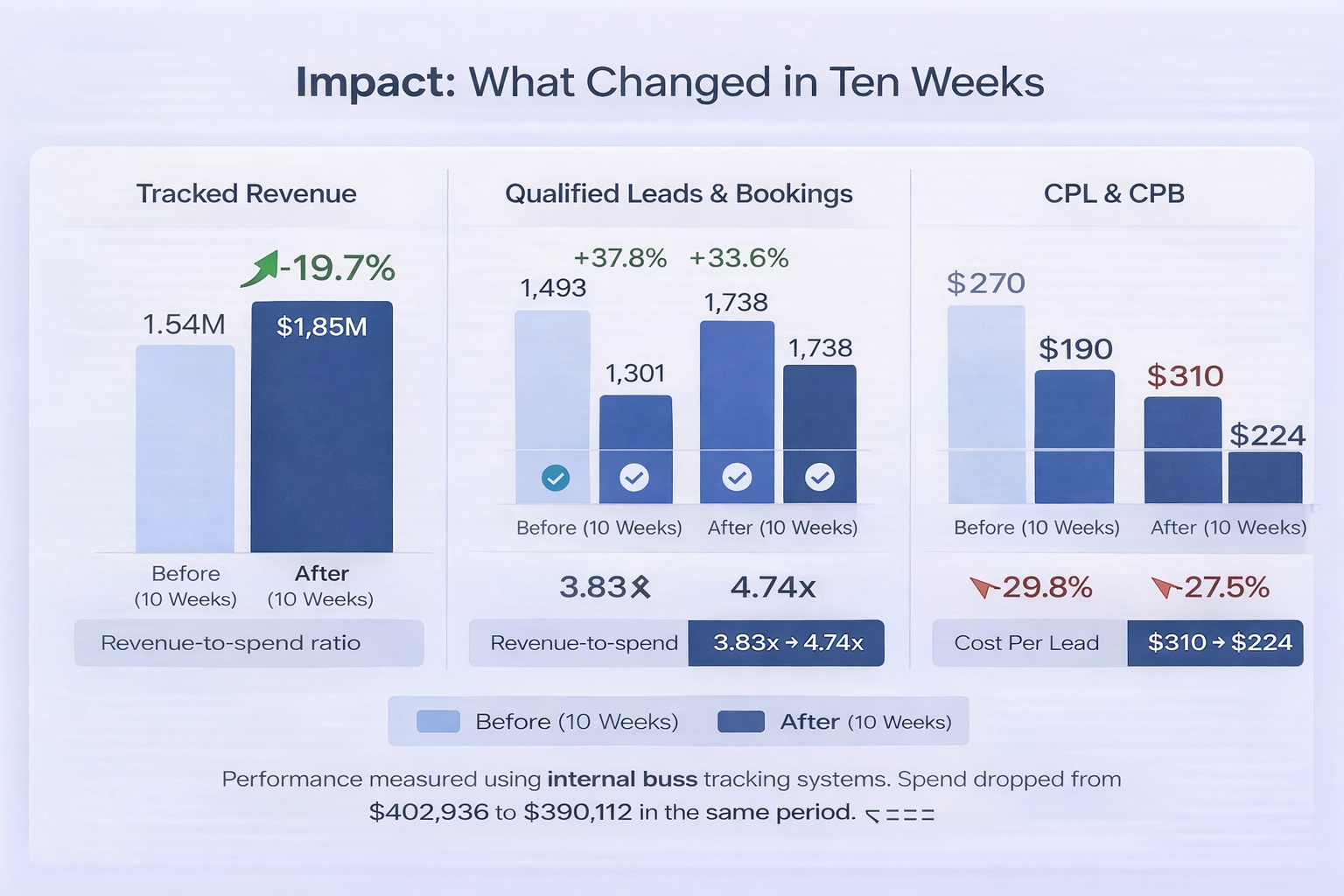
In the 10 weeks after I took over its Google Ads, a 14-location electrician franchise booked 1,738 jobs from the ads, up from 1,301 in the 10 weeks before. Ad spend stayed flat at about $390,000. Cost per booked job fell from $300 to $224, and tracked revenue rose 19.7%, from $1.54M to $1.85M.
Every figure here comes from the franchise’s own booking and revenue records, not from Google Ads. Two things went the other way, and both are on this page: revenue per booking fell about 10%, and three more locations were running ads after the takeover than before.
Want this checked on your own account? The Booked-Job Read is a free 30-minute review of your Google Ads and LSA with me. Get my Booked-Job Read
On this page
- What did the 10 weeks look like?
- What was the account like before?
- When did I take over?
- What changed?
- How was this measured?
- What got worse?
- What would I take from this?
- Questions owners ask about this
What did the 10 weeks look like?
| Measure | 10 weeks before | 10 weeks after |
|---|---|---|
| Cost per booked job | $300 | $224 |
| Booked jobs | 1,301 | 1,738+33.6% |
| Ad spend | $390,831 | $390,112−0.2% |
| Qualified leads | 1,347 | 1,497+11.1% |
| Tracked revenue | $1.54M | $1.85M+19.7% |
| Tracked revenue per $1 of ad spend | $3.95 | $4.74 |
Booked jobs rose faster than qualified leads. The franchise’s records count the two separately, so read each row against its own before number.
In the 10 weeks after, the locations running ads averaged roughly $13,000 a month each on Google Ads. Seven of the 13 spent under $15,000 a month.
What was the account like before?
From the outside it looked like one brand with one marketing plan. Inside, it ran like fourteen businesses. Each location had its own staff, its own booking habits and its own job values.
Performance was judged mostly inside Google Ads. Google Ads can show clicks and calls. It can’t show what got booked or what turned into revenue. Three things made the account hard to judge:
- No shared definition of a lead. Cost-per-lead conversations happened without the business context behind them.
- Calls were hard to tie to spend. Not with enough confidence to move budget on.
- The ads took the blame by default. When bookings dropped, the answer was “the ads”, even when the drop happened after the phone rang.
When did I take over?
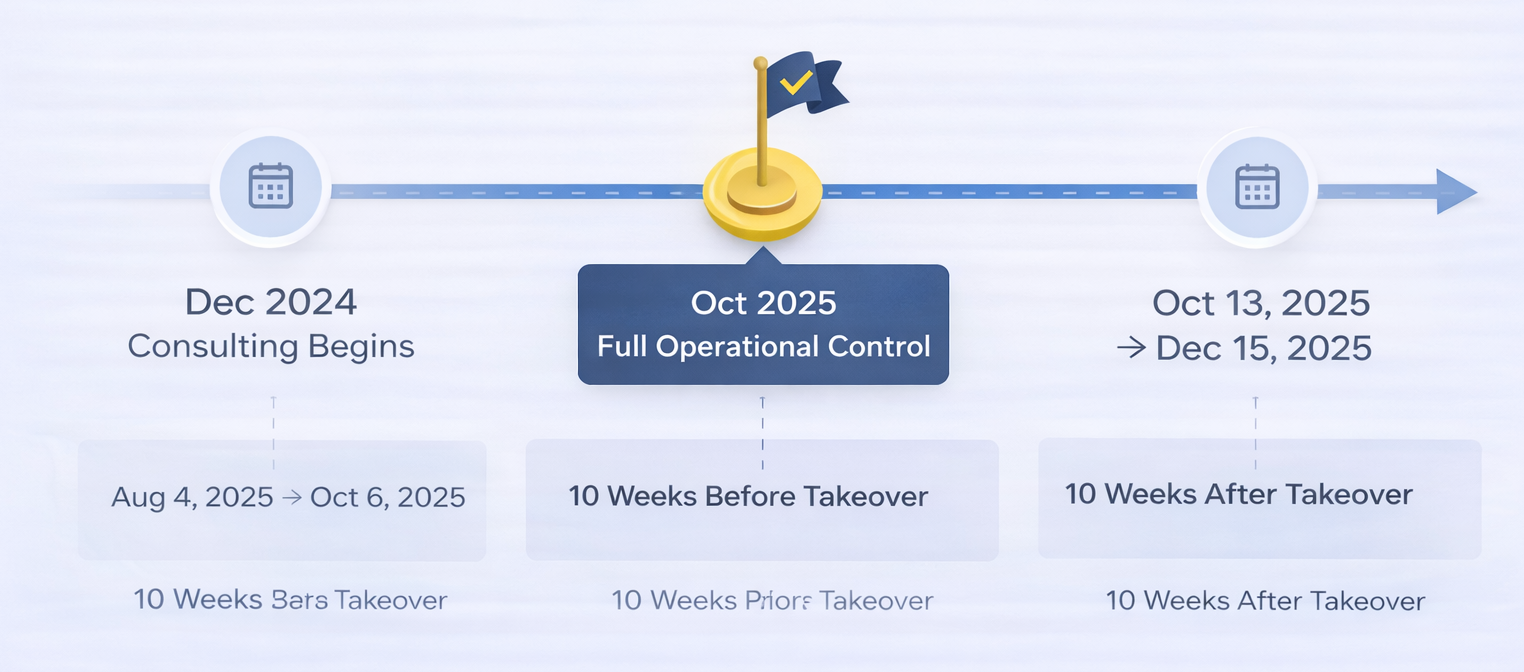
I started advising in December 2024, alongside the previous agency. In October 2025 I took full control of the Google Ads accounts across the network, and I still run them.
To isolate that change, this page compares the 10 full weeks right before the takeover (weeks starting Aug 4 to Oct 6, 2025) with the 10 full weeks right after (weeks starting Oct 13 to Dec 15, 2025). Back-to-back windows keep the season roughly the same.
What changed?
- One account structure. Campaign structure, naming and conversion definitions were made the same across every location, so the locations could be compared.
- A target per location. Each location got its own target, set from its own bookings and job values, not one number for the whole brand.
- Cleaner call tracking. Google-Ads-only phone numbers went into the ads and onto the website, so a call could be traced from the click to the booking and the revenue.
- Bidding on qualified leads. Google was pointed at leads the franchise marked as qualified, not at every call.
How was this measured?
Google Ads was used to steer the account, not to judge it. The franchise’s weekly records track the chain from qualified lead to booking to revenue, and only leads the franchise marked as qualified count.
Ten locations ran ads in the before weeks and 13 in the after weeks. Ad spend is from the same weekly records. Those records credit some jobs to ads that might have come anyway. None of this is a forecast for your business.
What got worse?
Revenue per booking fell about 10%, from about $1,187 to about $1,064. Pricing, job mix and how each office sells all move that number, and I can’t pin it on the ads alone. Tracked revenue still rose, because there were more bookings.
The after weeks had more locations running ads. Three locations that weren’t spending before were spending after. With the same 10 locations only, spend fell 6.8%, booked jobs rose 24.3%, and cost per booked job fell from $309 to $232. Qualified leads for those 10 rose 1.4%.
What would I take from this?
The chain runs from the ad to a qualified lead, an answered call, a booking, a kept appointment and revenue. The ads move the front of that chain. The office moves the rest. Judge the ads on the front, and show the office where the back drops.
A franchise needs one structure so the locations can be compared, and a target per location so each one stays profitable.
Questions owners ask about this
Is this one company or fourteen?
One franchise brand with 14 locations. Each location has its own Google Ads account.
Why not judge it in Google Ads?
Google Ads sees calls and forms. It doesn’t see which became booked jobs or what they paid. The franchise’s records do.
Did spend go down?
It stayed about the same: $390,831 before and $390,112 after. The gain came from booking more jobs on the same money.
Would this work for one location?
The method is the same. One location has fewer booked jobs for Google to learn from, so it takes longer. One electrical location from the same group went from $276 to $180 per booked job.